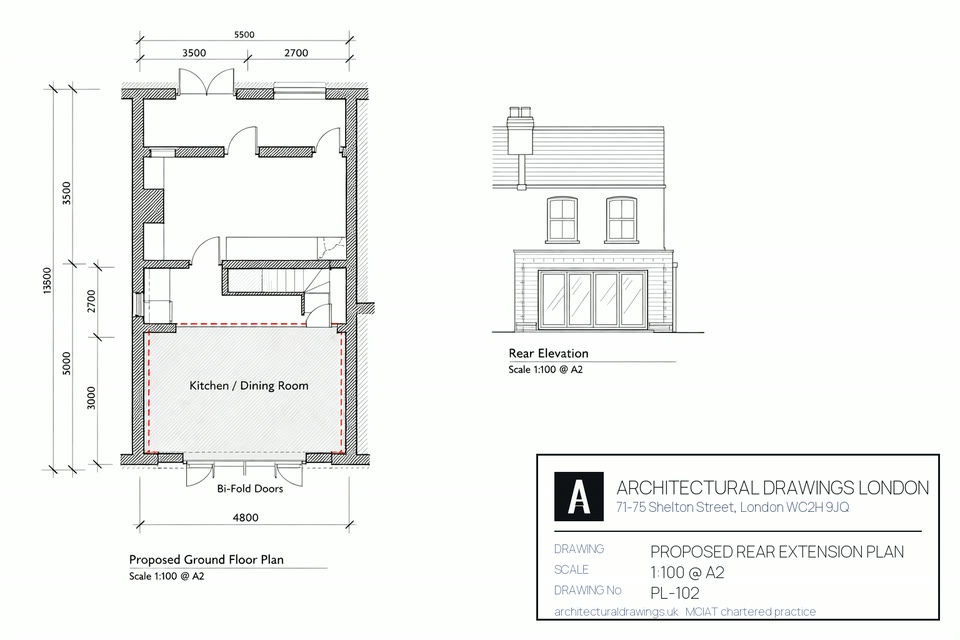
TL;DR — Key Facts
- Build cost per sqm: £2,200 – £3,200 (outer London borough)
- Council planning fee: £548 (householder application, 2026)
- Typical projects: rear extension, side-return, two-storey, wraparound
- Conservation areas: 4 designated areas in Barking and Dagenham
- Permitted Development: Generally available outside conservation areas
How does Barking and Dagenham handle an extension application?
Strictly. Barking and Dagenham granted 863 of the 1,239 householder applications it decided in the twelve quarters to March 2026 — 69.7%, the lowest rate of the 32 boroughs that report the split, where London as a whole runs at 83.0%. Across every application type it granted 65.7%, again the lowest in the capital. Its published eight-week figure of 100.0% should not be read as speed: the council returns every non-prior-approval householder decision in the fastest band and none in any slower one, in all twelve quarters, which is how the return was filled in rather than how long the work took.
| Measure | Barking and Dagenham | London |
|---|---|---|
| Householder approval rate | 69.7% | 83.0% |
| Householder decisions made | 1,239 | 77,680 |
| Refused | 376 | — |
| Approval rate, all application types | 65.7% | 81.0% |
| Larger householder prior approvals refused | 12.7% of 885 | 24.9% |
| Lawful development certificates recorded | 1,051 | — |
| Extension applications in the Datahub | 4,238 | 52% approved |
| Householder appeals allowed, 2016–2026 | 81 of 280 | England 35.6% |
Sources: decision figures from MHCLG District Planning Application Statistics (PS1 and PS2), twelve quarters to March 2026; Datahub row from the Planning London Datahub, retrieved 15 August 2026, phrase-matched and comparable within this borough only; appeals from Planning Inspectorate casework decided 1 July 2016 to 30 June 2026, householder cases only, where an allowed appeal means a refusal overturned and is not an approval rate. Open Government Licence v3.0. We have left the council's eight-week timeliness figure out of this table on purpose: it reads 100.0% in every quarter with nothing in any slower band, which describes the return rather than the service. Build costs on this page are our own 2026 London range and are an estimate.
What does a Becontree extension cost in 2026?
Costs here are build costs. For the drawing package itself — scope, fee and timeline — see house extensions in Barking and Dagenham.
Reckon on £2,200 to £3,200 per square metre for the build. That is an outer-London rate, and it is the rate that fits a borough where the median home changed hands for £385,000 in 2025 across 1,343 registered sales — a terraced house for £400,000, a semi for £435,000 (HM Land Registry Price Paid Data, calendar year 2025). Drawings, the planning fee and VAT all sit on top. The ratio of extension cost to house value is tighter here than almost anywhere in London, which is a reason to get the structural design settled before the kitchen.
What moves a Becontree extension up its range is almost never the finish. It is the structure: these houses were built with modest spans and load-bearing internal walls, so opening the back up means a steel and a padstone design before any kitchen is chosen. Get the structural scheme priced early, because it is the item that varies most between two apparently identical houses on the same street.
Typical extension costs in Barking and Dagenham (build only)
On top of the build cost, you will need architectural drawings. These fees are 30% below typical London architect rates.
What changes the price on a Becontree Estate house?
Two things set extension costs apart in Barking and Dagenham. The Becontree Estate was laid out in the 1920s and 1930s with wide roads and generous plots, which usually means a machine can reach the rear and spoil can leave without going through the house. Against that, much of the stock was sold under right to buy and carries covenants, so a former landlord's consent can be a requirement the planning system never mentions.
Conservation areas
There are four, and you can check all four by name. Abbey and Barking Town Centre, reference CA004, was designated on 10 August 1975 and covers 16.2 hectares — three quarters of the borough's designated land on its own. Chadwell Heath Anti-aircraft Gun Site, CA002, followed on 9 January 1990 at 2.1 hectares. Dagenham Village, CA001, was designated on 31 January 1995 and covers 2.6 hectares, and Abbey Road and Riverside, CA003, on 6 December 1995 at 0.6 hectares. Together that is about 22 hectares of a 3,778-hectare borough. If your address is inside one, permitted development rights narrow and a full application at £548 becomes likely; if it is not, and statistically it is not, the designation is simply irrelevant to your project.
Property type
One decade built most of this borough. As at 31 March 2025, 35.0% of its 81,790 homes dated from 1919 to 1929, against 6.2% across London — the most lopsided build-period profile of any London borough, and the Becontree Estate is the reason. Only 1.2% predate 1900. In practice that means cottage-estate housing with modest spans, load-bearing internal walls and no basement, which suits a single-storey rear extension or a two-storey rear addition and rules out the side-return solutions that work on a Victorian terrace. Note the share is falling as the borough builds — it was 39.0% in 2015 — while the number of 1920s houses has barely moved. Newer riverside flats are diluting the percentage, not replacing the estate (VOA council tax stock data).
Access and logistics
Becontree houses generally have side or rear access, and that is worth more to an extension budget than any planning advantage. Where a digger and a skip can reach the garden directly, excavation and muck-away are ordinary line items; where they cannot, every barrow goes through the hall and the labour cost of the groundworks changes shape entirely. Check the side gate width before you price anything.
Our drawing fees for Barking and Dagenham extensions
Fixed fee, quoted up front, no hourly billing. Given how often this council refuses — 376 householder refusals in three years — the part of the fee that earns its keep is the work before submission: checking the design against what has actually been granted nearby, rather than against what the guidance says ought to be. The package covers a valid submission to Barking and Dagenham Council and the building regulations drawings the builder works from.
Drawing fees for extensions in Barking and Dagenham
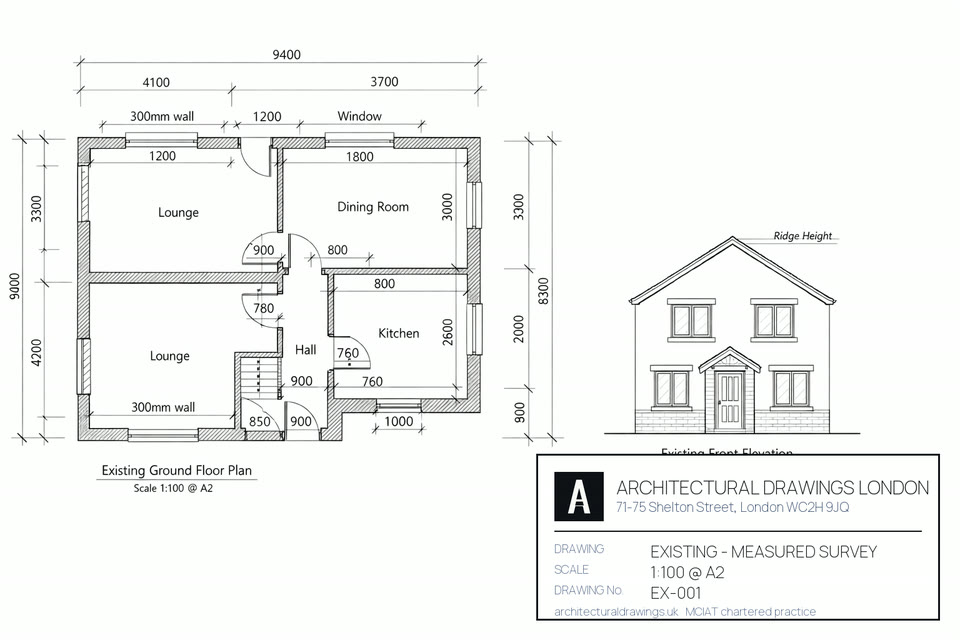
Every package includes a measured survey of your existing property, existing floor plans and elevations, proposed floor plans and elevations, a site plan, and a design and access statement where required. Our MCIAT chartered architectural technologists handle the full process from survey to submission, and we liaise with Barking and Dagenham Council on your behalf.
We cover all Barking and Dagenham postcodes: IG11, RM6, RM8, RM9, RM10.
Planning or permitted development in Barking and Dagenham?
The permitted development route is unusually productive here, and the numbers say so plainly. Of 885 larger householder extensions put through the neighbour-consultation process in the three years to March 2026, 743 were told prior approval was not required and only 112 were refused — a 12.7% refusal rate against 24.9% across London. That is the mirror image of the borough's record on full applications. The allowance itself is the national one: 6 metres beyond the original rear wall for a terrace or semi, 8 metres for a detached house, single storey, with the council notifying the neighbours either side.
With four conservation areas covering roughly 22 hectares, this borough has the smallest designated footprint in London, so the overwhelming majority of addresses keep their permitted development rights intact. Where a designation does apply, the rule that bites on cottage-estate housing is materials: these streets repeat the same brick and the same render for hundreds of metres, and a change that would disappear into a mixed Victorian street reads as a gap in a pattern here. There is a second constraint the planning system never mentions. Much of the stock was sold under right to buy and carries covenants from the former landlord, so freeholder consent can be needed for work that needs no permission at all.
Two-storey extensions need full permission almost without exception. On Becontree the difficulty is uniformity: the estate was built to a handful of repeated designs, so a first-floor addition is read against an unbroken roofline running the length of the street rather than against your house alone. Schemes that step the upper floor back from the original eaves line sit far more comfortably in that context.
Barking and Dagenham issued 1,051 certificates of lawful development in three years (MHCLG planning statistics, retrieved 1 September 2026), against 1,239 householder decisions - one of the highest ratios in London. On an estate of near-identical houses that makes obvious sense: the permitted development position is usually clear, and the certificate turns a clear position into a document. It costs a fraction of an application and it is what a buyer's solicitor asks for.
Frequently asked questions
How much does a house extension cost in Barking and Dagenham?
Between £2,200 and £3,200 per square metre for the build, so a single-storey rear extension of 15 to 20 square metres lands somewhere between £33,000 and £64,000 before anything else. Add the drawings, the £548 householder application fee if you need permission, a structural engineer for the opening into the existing rear wall, and VAT. One local variable worth pricing early: about a quarter of the borough's land sits in Environment Agency Flood Zone 3, so on a low-lying plot the application may need a Flood Risk Assessment, and the ground floor build-up may need rethinking.
Can I extend under Permitted Development in Barking and Dagenham?
Yes, and more often than the borough's refusal record might lead you to expect. A single-storey rear extension can run to 6 metres past the original rear wall on a terrace or semi, or 8 metres on a detached house, using the prior approval route that lets the neighbours object. Only four small conservation areas restrict those rights anywhere in the borough. Because the Becontree houses repeat so exactly, the permitted development position on your address is usually already settled by the ones around it — which is why a Lawful Development Certificate at £274 is such good value here. It converts a clear position into the document a buyer's solicitor will ask for.
How long does a house extension take in Barking and Dagenham?
A typical house extension project in Barking and Dagenham takes 5-8 months from initial instruction to completion. This breaks down as: 2-3 weeks for measured survey and drawing preparation, 8 weeks for planning determination by Barking and Dagenham Council (if required), 2-4 weeks for building regulations approval, and 8-16 weeks for construction depending on the size and complexity of the extension.
Do I need a Party Wall Agreement for an extension in Barking and Dagenham?
On a Becontree terrace or short semi-detached run the Party Wall etc. Act 1996 is engaged almost immediately, because a rear extension foundation will sit within three metres of the neighbour's. Notice runs one month for excavation and line-of-junction work, two months for work to the wall itself. It applies whether or not the council needs to see the scheme.
What experience do you have with extensions in Barking and Dagenham?
We prepare extension drawings for properties across all Barking and Dagenham postcodes (IG11, RM6, RM8, RM9, RM10). Our MCIAT chartered architectural technologists understand Barking and Dagenham Council's policies, design guides, and local precedents. We have a council-ready drawing review across all 33 London boroughs.