North London architects and chartered technologists
North London is the half of the capital where Article 4 directions bite hardest. Camden, Islington and Haringey have all withdrawn permitted development rights across substantial areas, so the first question on any North London project is which route it takes, not what it looks like.
Six boroughs make up North London for planning purposes, and they behave very differently from one another. Barnet and Enfield are large, suburban and dominated by interwar semi-detached stock with wide permitted development scope. Camden and Islington are dense, heavily designated, and among the most restrictive planning authorities in England. Haringey and Harrow sit between the two.
Why does Article 4 matter so much in North London?
An Article 4 direction withdraws a permitted development right in a defined area, so work that would be automatic elsewhere needs a full planning application at £548 instead of a £274 certificate. North London carries more of these directions than any other part of the capital, and their boundaries are frequently drawn street by street — sometimes one side of a road only.
Camden operates directions covering roof alterations and changes to front elevations across large parts of the borough, alongside more than forty conservation areas. Islington is similarly designated, with the Georgian and early Victorian terraces around Barnsbury, Canonbury and Clerkenwell under tight control on anything visible from the street. Haringey has directions aimed at the Edwardian terraces of Harringay and Crouch End, and Hackney and Waltham Forest apply similar controls immediately to the east.
Barnet and Enfield are the counterweight. Both are dominated by 1920s and 1930s semi-detached housing outside designated areas, where a rear dormer within the 50 cubic metre allowance and a 3 metre rear extension remain genuinely permitted development. That is why an identical brief produces a certificate in Enfield and a full application with a heritage statement in Camden.
What kind of work comes up in North London?
Hip-to-gable loft conversions on the interwar semis of Barnet, Enfield and Harrow — squaring the hipped end typically recovers 6 to 9 square metres of usable floor.
Mansard roofs on the Camden and Islington terraces, where the existing ridge is too low for a dormer and a full roof rebuild is the only route to a usable storey.
Side return and wrap-around extensions on the Victorian terraces of Crouch End, Stroud Green and Highbury.
Basement and lower-ground alterations in Camden, which operates one of the strictest basement policies in the country and requires a structural and hydrological assessment.
Flat and maisonette works, which carry no permitted development rights at all and always need a full application.
Package
Fixed fee
Turnaround
Essentials — measured survey, existing and proposed plans
Complete — planning plus building regulations drawings
20–28 working days
What do North London councils charge and how long do they take?
Statutory application fees are set nationally, so they are identical in every North London borough. What differs is validation practice and workload — the busiest boroughs take longer to register an application, and the eight-week clock does not start until they do.
Application type
Statutory fee
Determination
Householder application (extension, loft, dormer)
£548
8 weeks
Full application — new dwellinghouse
£610
8 weeks
Lawful Development Certificate (proposed)
£274
8 weeks
Listed building consent
No fee
8 weeks
Prior approval — larger rear extension
£249
6 weeks
We submit through the Planning Portal in your name, respond to every case-officer query and issue amended drawings as needed through to the decision notice, at no additional charge.
For planning purposes we treat Barnet, Camden, Enfield, Haringey, Islington and Harrow as North London. Each is a separate local planning authority with its own Local Plan, validation list and Article 4 directions, so the route your project takes depends on the borough and often on the individual street.
Is a loft conversion permitted development in North London?
In Barnet, Enfield and much of Harrow, usually yes — a rear dormer within 40 cubic metres on a terrace or 50 on a semi. In Camden, Islington and designated parts of Haringey, Article 4 directions and conservation-area status frequently remove the right, converting it into a full £548 application.
How do I find out if Article 4 applies to my street?
The borough publishes its directions and conservation-area boundaries on its own planning maps, and the boundary is often one side of a road. We check the designation for your specific address before quoting, because getting it wrong costs eight weeks.
Do you charge more for Camden or Islington projects?
No. The fee is fixed by package, not by borough. A designated property needs more supporting material — a heritage statement, a fuller design justification — and that is inside the quoted fee rather than added afterwards.
How long does a North London application take?
Eight weeks from validation for a householder application, plus one to three weeks before that for registration in the busier boroughs. Applications decided at planning committee rather than under delegated powers add a further three to six weeks.
Last updated: 28 July 2026 · Written by the Architectural Drawings London
technical team, chartered members of the Chartered Institute of Architectural
Technologists (MCIAT). · About our team
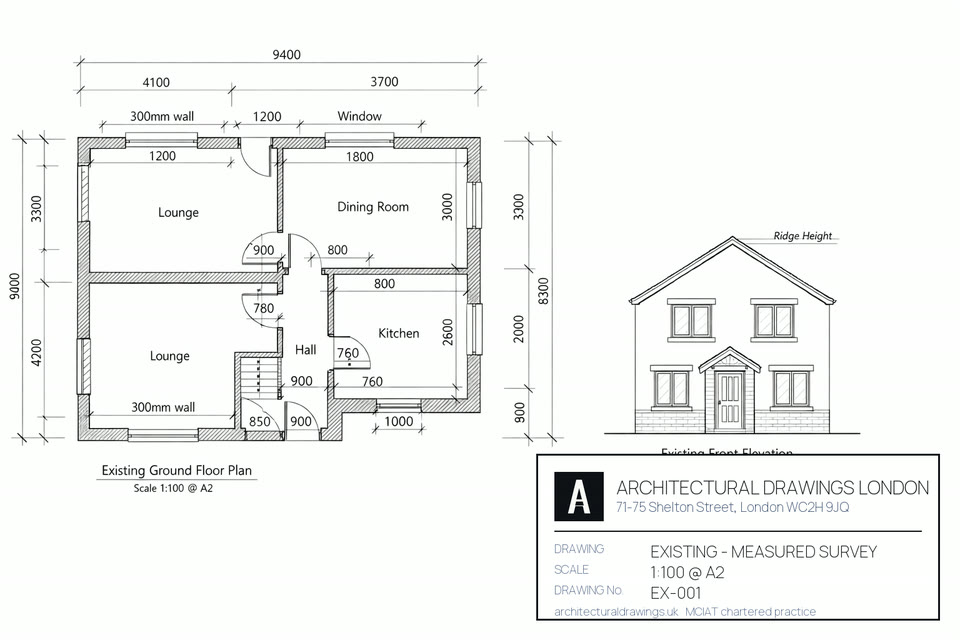
Measured surveyEvery dimension recorded on site in a measured survey before a line of the proposal is drawn.
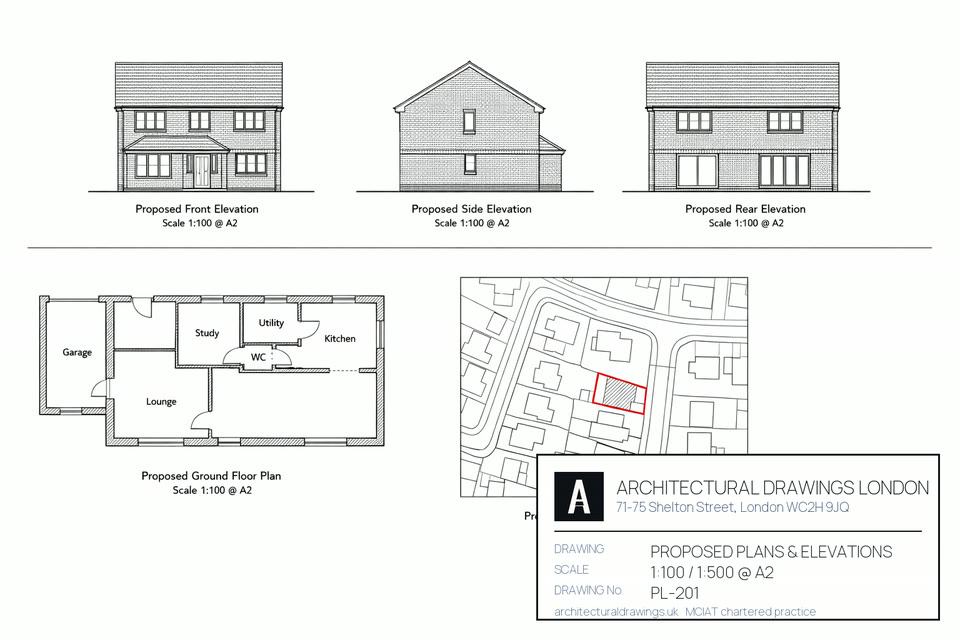
Planning application setExisting, proposed and location plans on one sheet — as the council receives it through the Planning Portal.
The exterior of a london house before works — north london architects and chartered technologists in London.
Get a North London project priced
Send the postcode. We check the Article 4 and conservation-area position for your street before quoting.