TL;DR — Key Facts
- Planning authority: Enfield Council
- Conservation areas: 22 designated areas
- Article 4 Directions: None currently in force
- Postcodes covered: EN1, EN2, EN3, N9, N11, N13, N14, N18, N21
- Typical housing: Edwardian villas in Palmers Green and Winchmore Hill
- Householder application fee: £548 (2026 rate)
Why does Enfield rarely extend the clock?
Enfield agreed an extension of time on just 6.7% of its applications, against 34.5% across London and 48.9% in neighbouring Ealing. It approved 77.8% of 2,814 householder decisions. An application that cannot be determined as submitted is more likely to be refused here than renegotiated.
| Measure | Enfield | London |
|---|---|---|
| Applications with an agreed extension of time | 6.7% | 34.5% |
| Householder approval rate | 77.8% | 83.0% |
| Householder decisions made | 2,814 | 77,680 |
| Decided inside eight weeks | 91.0% | — |
| Lawful development certificates issued | 1,810 | — |
| Article 4 areas in the national register | 33 | — |
| Householder appeals allowed after refusal | 34.6% of 612 | 40.8% of 13,067 |
Sources: decision figures from MHCLG District Planning Application Statistics (PS1 and PS2), twelve quarters to March 2026; Article 4 areas from the MHCLG Planning Data Platform register, retrieved 1 September 2026, excluding revoked entries; appeals from Planning Inspectorate casework decided 2016–2026. Open Government Licence v3.0.
Planning in Enfield — what you need to know
Enfield served 692 planning contravention notices in three years, more than any other London borough and half as many again as the next (MHCLG planning statistics, retrieved 1 September 2026). A contravention notice is a formal demand for information about what is happening on a site, so this is a council that investigates first and decides afterwards. If work has already started on your property without consent, Enfield is one of the likeliest boroughs in London to ask about it.
Outer north London; Metropolitan Green Belt affects north; generally permissive elsewhere. The borough has a population of approximately 334,000 residents and covers postcodes EN1, EN2, EN3, N9, N11, N13, N14, N18, N21.
Enfield's 128,340 homes divide unusually cleanly by date. Some 28.3% were built between 1930 and 1939 and 10.7% before 1900 (VOA council tax stock by build period at 31 March 2025, retrieved 1 September 2026), and on the ground those two figures sit in different places rather than mixed together. The Victorian and Edwardian stock runs south and west — the villas of Winchmore Hill and Palmers Green, the terraces of Edmonton — while the interwar expansion filled Southgate and the streets around the Piccadilly line stations. North of Enfield Town the Metropolitan Green Belt takes over and the question changes entirely, from what a building should look like to whether it should be there. Establishing which of the three you are in decides everything downstream, and it is not always obvious from the postcode.
With 22 designated conservation areas and no current Article 4 Directions,Enfield records 33 Article 4 areas against 22 conservation areas, and the Metropolitan Green Belt covers much of the north of the borough beyond Enfield Town. The result is three distinct planning contexts within one authority: the Edwardian villa streets of Winchmore Hill and Bush Hill Park, the interwar semis of Southgate and Palmers Green, and the Green Belt fringe where even modest outbuildings are assessed against openness policy.
Architectural Drawings London works across every Enfield postcode, from the EN2 fringes to the N-district streets in the south of the borough, producing planning submissions and building regulations packages. Most of the difference between an approval and a resubmission lies in anticipating the local policy the officer will cite and the neighbouring decisions they will treat as settled.
Where do Enfield’s 33 Article 4 areas apply?
Enfield's Article 4 areas are local rather than borough-wide, so ordinary householder rights — lofts, rear extensions, outbuildings — survive across most of the borough. Look up the address on the council's policies map rather than assuming from the neighbourhood, because the boundaries here follow individual street groups and do not track the conservation area boundaries.
Where the rights do survive, Enfield uses them freely. Of 868 larger rear extensions notified under the prior approval procedure in the twelve quarters to March 2026, 680 were returned as prior approval not required and 94 refused — a 78.3% clearance, third highest of the twenty-seven boroughs the national return supports a rate for (MHCLG planning statistics, retrieved 1 September 2026). There is a scheduling point buried in the same return that few boroughs can match. Enfield agreed an extension of time on 6.7% of its 5,493 decisions, the lowest share in London and less than half the next lowest, against a capital-wide 34.5%. Most councils manage the eight-week clock by asking the applicant to stop it. This one does not, which makes a stated Enfield timetable unusually close to the real one.
A lawful development certificate at £274 is still the sensible companion to any permitted development project here, and Enfield owners clearly agree: 1,810 were recorded over the same three years. The national return carries no granted-or-refused split for certificates in any English authority, so treat that as a measure of demand rather than of success. Given how actively this council investigates unauthorised work, holding the certificate before the scaffold goes up is worth considerably more than obtaining one afterwards.
How many conservation areas does Enfield have?
Enfield has 22 designated conservation areas. Notable conservation areas include:
- Forty Hill
- Enfield Town
- Gentleman's Row
- Winchmore Hill
- Bush Hill Park
Designation strips out chunks of what you could otherwise build without asking. Inside an Enfield conservation area the following stop being permitted development:
- No cladding, stone, artificial stone, pebble dash, render, timber, plastic, or tile to any external wall without planning permission
- No side extensions under Permitted Development
- Rear extensions are limited and may require planning permission
- Dormer loft conversions facing the highway require planning permission
- Satellite dishes on front elevations or chimneys are not permitted
- Demolition of gates, walls, fences, or other boundary treatment requires planning permission
Twenty-two designated areas, with no Article 4 Direction covering the borough, which leaves the conservation boundary doing all of the restricting on its own. Enfield delegates 98.8% of decisions to officers (MHCLG planning statistics, retrieved 1 September 2026), so the appraisal document for your specific area is the standard being applied. Given the borough's investigative record, a lawful development certificate is worth more here than in most of London: it is documentary proof, held in advance.
Popular projects in Enfield
Palmers Green and Winchmore Hill Edwardian villas, Southgate semis, Edmonton terraces, and Metropolitan Green Belt across the north of the borough. Enfield took 5,493 planning decisions in three years and approved 73.4%, with new-dwelling proposals at 55.9% (MHCLG planning statistics, retrieved 1 September 2026). The Green Belt is what separates the two halves: a plot inside it faces a test about the principle of development, not merely its design.
Loft conversions
Two roof types, two different jobs. On the Edmonton and Palmers Green terraces a rear box dormer is the standard answer and returns 20 to 30 square metres; on the Southgate semis the hip has to be squared off to a gable first, which costs more and yields more. Both usually sit inside permitted development outside a designated area, and the practical Enfield question is what you do about proof. Because the council is one of the more investigative in London, and because a dormer is visible from the moment it is framed, the sequence we recommend here is survey, then certificate, then build — not build and argue. Inside Forty Hill, Gentleman's Row, Enfield Town, Winchmore Hill or Bush Hill Park the roof allowance is switched off outright and the dormer becomes a householder application at £548.
Side-return and rear extensions
The Edwardian villas around Winchmore Hill and Bush Hill Park were built with a narrow side return alongside the back addition, and filling it is the single most common way of turning a cramped galley kitchen into a room the household uses. Depth is the other half of the question: three metres on a semi-detached or terraced house under the ordinary allowance, six under the larger-extension prior approval procedure, eight if the house is detached. Enfield's record on those notifications is permissive, with 680 of 868 cleared without prior approval being required over three years. What the allowance never covers is the side return itself where the extension sits beside rather than behind the original wall — that is a side extension, and inside a conservation area it is not permitted development at all.
Two-storey extensions
Going up as well as out always needs a full application — there is no notification route for a second storey — and Enfield grants 77.8% of the householder applications it decides, below the London figure of 83.0% and 27th of the thirty-two boroughs whose rate the return supports (MHCLG planning statistics, retrieved 1 September 2026). That is not a discouraging number so much as a reason to design to the tests rather than to the plot. Three of them decide most schemes here: the addition stays subordinate to the original house, with its ridge set below the existing; it steps in from the flank boundary so the neighbouring garden and any flank windows keep their outlook; and the rear depth is checked against the 45-degree line from the nearest neighbouring habitable window. On a two-storey addition the second of those matters far more than it does at ground floor, because the massing is what the neighbour sees and what the objection will describe.
How much do planning drawings cost in Enfield?
The council charge is only part of it. What is unusual about Enfield is how rarely the timetable slips — just 367 applications had an extension of time agreed, 6.7% of decisions and the lowest rate in London (MHCLG planning statistics, retrieved 1 September 2026). You can plan around the statutory period here with more confidence than almost anywhere. We set one drawing fee at the outset; it comes in near a third below the equivalent London architect charge.
Planning costs in Enfield
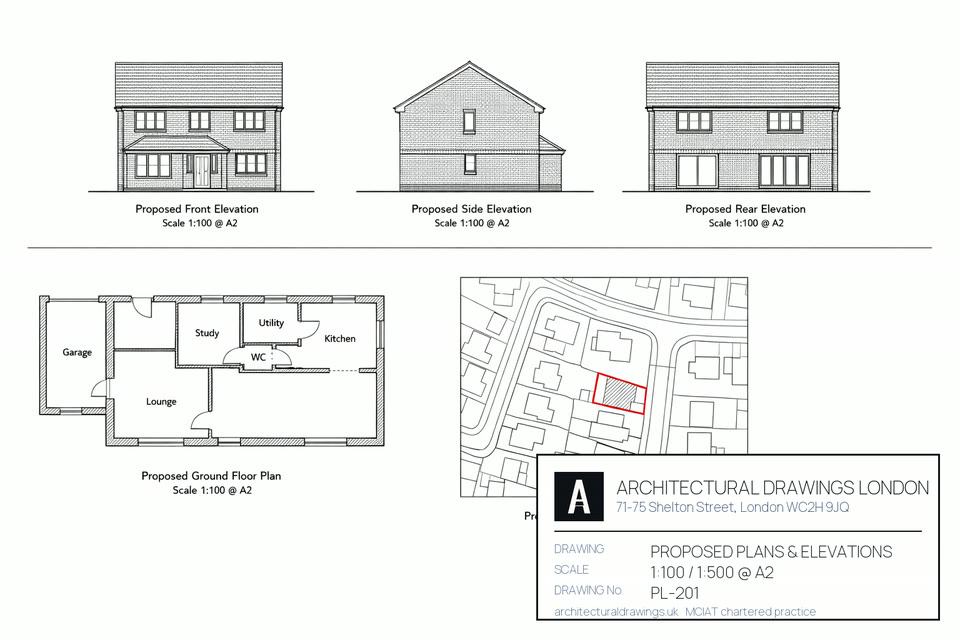
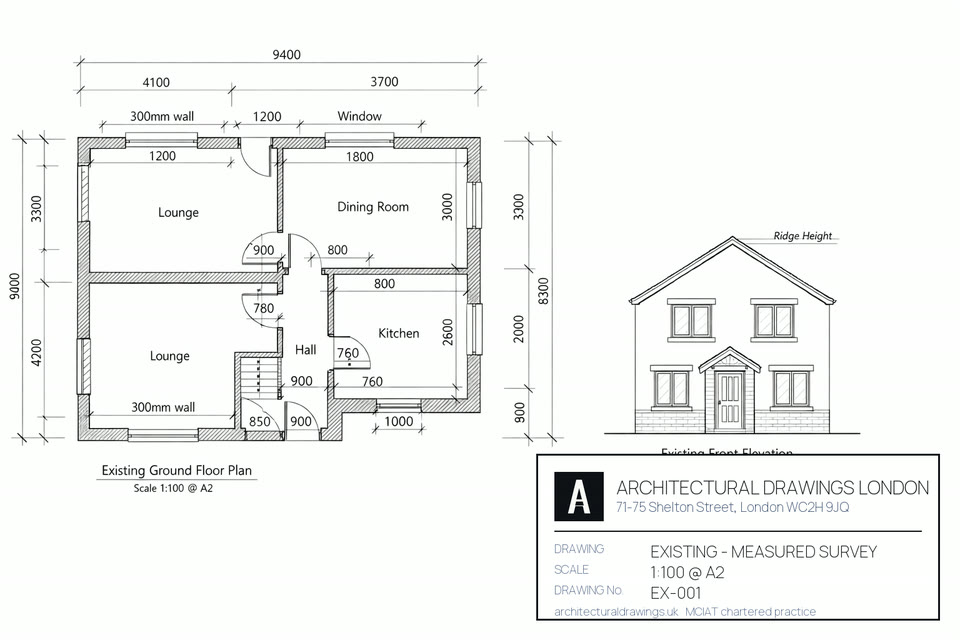
What goes in: a measured survey, plans of the house as it stands and as you want it, the elevations that go with them, and a site plan. That is the list Enfield's validation officer works down before registering an application. We price that scope 30% under what a London architect's practice typically charges for it.
A Lawful Development Certificate for proposed works is obtained before building and confirms the scheme is permitted; one for existing works establishes that something already built is lawful. In the borough that issues the most contravention notices in London, the proposed form is the direct answer to the question a notice asks. Enfield granted 1,810 certificates over three years (MHCLG planning statistics, retrieved 1 September 2026).
Our experience in Enfield
We cover all Enfield postcodes: EN1, EN2, EN3, N9, N11, N13, N14, N18, N21. Whether your property is in a conservation area, affected by an Article 4 Direction, or in an unrestricted residential street, we have experience with Enfield Council and understand the borough's planning policies.
Planning and building regulations drawings for houses and flats across Enfield are drawn by MCIAT chartered architectural technologists. The job runs from the first measured survey to the point the council registers the application, and correspondence with the case officer comes to us rather than to you.
We also work in Enfield's neighbouring boroughs:
What are the odds of approval in Enfield?
Enfield refuses more householder applications than London does, and the gap is wide enough to plan around. Of 2,814 householder decisions taken in the three years to March 2026, 2,188 were approved and 626 refused: 77.8% approved, where the 33 boroughs together sit at 83.0%. Call it five points of extra downside. It is the reason a weak application posted to see what happens is a poor tactic here — the drawings and the supporting statement have to do their work on the first pass.
Almost nothing in Enfield reaches a committee. Across 2023-24 to 2025-26, officers settled 5,425 of the borough's 5,493 applications under delegated powers: 98.8%, where the 33 boroughs pooled reach 97.0%. Sixty-eight decisions in three years went to members. Practically, that means your application is judged against written policy by a case officer rather than argued in a room, so the drawings and the covering statement carry the case on their own. Enfield also decided 91.0% of householder applications inside eight weeks, close to the London figure of 92.5%, so the statutory period is a fair planning assumption without being a promise. Source: MHCLG live planning statistics.
Nine in ten get through. Enfield determined 868 larger rear extensions under the neighbour consultation scheme, and the commonest outcome was neither a grant nor a refusal: 680 of them, 78.3%, were told prior approval was not required, which is the council saying build it. Another 94 were granted and 94 refused. Add the first two together and 89.2% ended up free to proceed, with roughly one in nine stopped. The trap is reading 'not required' as a rejection, which turns a comfortable margin into a coin toss and gets the answer exactly backwards.
Enfield also recorded 1,810 certificates of lawful development across those twelve quarters, a large count set against a householder caseload of 2,814. Read it as a borough where a lot of work goes ahead under permitted development and is then evidenced on paper rather than being submitted for permission. The fee for a lawful development certificate is £274, and the certificate is the document a buyer's solicitor asks to see. No approval rate can be quoted for certificates: the national return does not separate grants from refusals for any English authority.
Every number on this page comes from the PS1 and PS2 returns Enfield files with MHCLG each quarter. What they count is decisions, quarter by quarter from 2023-24 through 2025-26, rather than the applications that went in. A scheme lodged in 2022 and settled in 2024 therefore lands in the 2024 column. Contains public sector information licensed under the Open Government Licence v3.0
Frequently asked questions
Do I need planning permission in Enfield?
Frequently, and Enfield householders establish it more often than almost anyone: the council issued 1,810 lawful development certificates and granted 680 prior approvals for larger rear extensions (MHCLG planning statistics, retrieved 1 September 2026). Those two numbers together describe a borough where the permitted development route is well understood and heavily used. The limits are the 33 Article 4 areas and the Green Belt in the north, where permitted development rights for outbuildings and extensions are materially tighter than the national default.
Does Enfield have Article 4 Directions?
Nothing borough-wide in Enfield takes householder permitted development rights away under Article 4. That is not the same as your own house having them: a planning condition on an earlier permission can remove rights on one plot, and conservation area designation cuts them back separately. Check the title and the planning history for the address before assuming anything is free.
How many conservation areas are in Enfield?
Twenty-two, weighted heavily towards the older centres — Forty Hill, Enfield Town, Gentleman's Row, Winchmore Hill and Bush Hill Park. Gentleman's Row is the tightest of them, a surviving eighteenth-century terrace where almost nothing is permitted development. Elsewhere the standard restrictions apply: no cladding or render, no side extension, no street-facing dormer, and boundary walls cannot be demolished without consent. Enfield's 33 recorded Article 4 areas overlap these designations but are not identical to them, so both need checking.
How much does a London Borough of Enfield planning application cost?
The application fee is £548 and a certificate £274, both nationally set. Enfield's distinguishing figure is 692 planning contravention notices in three years (MHCLG planning statistics, retrieved 1 September 2026), more than any London borough - a formal demand for information about work on a site. Budgeting here should include establishing your position on paper before starting, not only paying to determine it afterwards.
How long does London Borough of Enfield take to decide a planning application?
Enfield decided 91.0% of householder applications inside the statutory 8 weeks with 2.6% running beyond thirteen, across 2,814 decisions (MHCLG planning statistics, retrieved 1 September 2026). It also refused 626 of them — a 77.8% approval rate that sits below the London norm, so the realistic planning horizon here is fourteen to sixteen weeks including the possibility of revision. Allow four to six weeks more for pre-application advice, which is worth taking on a Green Belt site. Major applications carry a thirteen-week target.