Where in Camden does a side return actually get determined?
Every Camden postcode district we draw in, the stock that dominates
it and the authority that validates a side return there. Camden fees below are the
statutory England rates for 2026, not side return estimates.
| Postcode | Area | Dominant stock | What it means for a side return |
|---|
| EC1N | Hatton Garden | Victorian and Edwardian terraces | Hatton Garden sits wholly inside EC1N, so Camden Council validates every side return submitted from an EC1N address. |
| N19 | Archway / Tufnell Park | Victorian terraces, post-war flats | Archway / Tufnell Park is split at N19. Either Islington Council or Camden Council can determine a side return here, so the N19 address is checked against both policies maps first. |
| NW2 | Cricklewood / Neasden | Edwardian villas and terraces | A side return in Cricklewood / Neasden may land with Brent Council or Barnet Council or Camden Council — NW2 crosses the boundary, and the NW2 policies map decides it street by street. |
| NW8 | St John's Wood | Victorian villas, mansion blocks | A side return in St John's Wood may land with Westminster City Council or Camden Council — NW8 crosses the boundary, and the NW8 policies map decides it street by street. |
| WC2B | Covent Garden / Holborn | Victorian and Edwardian terraces | A side return in Covent Garden / Holborn may land with Westminster City Council or Camden Council — WC2B crosses the boundary, and the WC2B policies map decides it street by street. |
| N1C | King's Cross | Modern apartments, converted warehouses | N1C covers King's Cross only; Camden Council handles the side return. |
| N6 | Highgate | Georgian villas, Victorian and Edwardian semis | A side return in Highgate may land with Camden Council or Haringey Council — N6 crosses the boundary, and the N6 policies map decides it street by street. |
| NW1 | Camden Town / Regent's Park | Victorian terraces, mansion blocks | Camden Town / Regent's Park is split at NW1. Either Camden Council or Westminster City Council can determine a side return here, so the NW1 address is checked against both policies maps first. |
How does a side return differ street by street across Camden?
Roof pitch, wall build-up and plot depth change every few Camden
streets, and each one changes what a side return can achieve at that address.
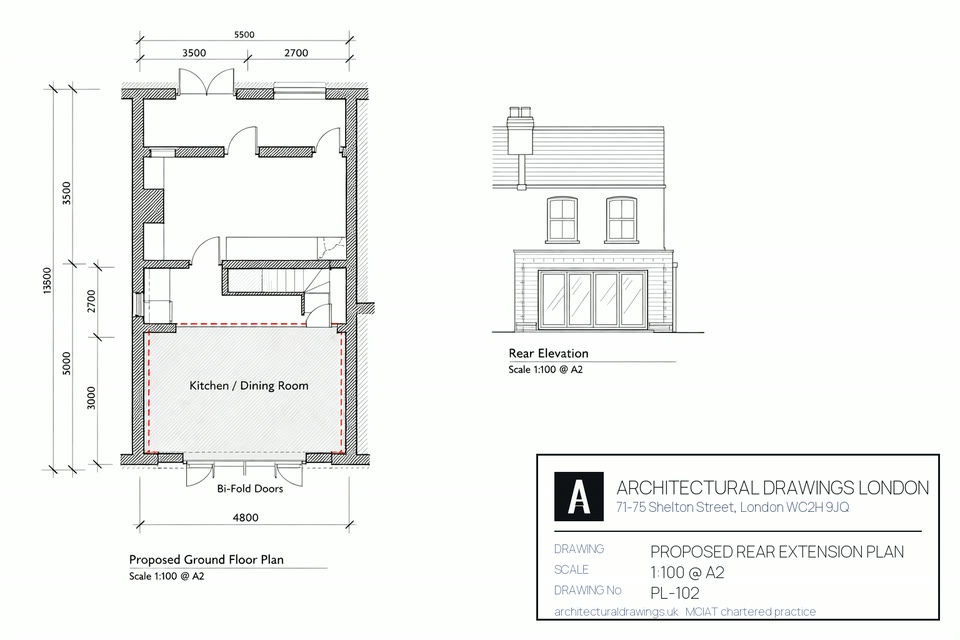
- West Hampstead (NW6) — Victorian and Edwardian villa streets defines West Hampstead, where edwardian mansion blocks, victorian villas set what a side return can do. The side-return infill is the classic move on these Victorian terraces — 3 m of permitted development depth plus the width of the original side passage across NW6. Any West Hampstead side return is validated by Camden Council, with West Hampstead Thameslink the usual West Hampstead reference point on the site plan.
- Camden Town (NW1) — side return work in Camden Town means victorian terraces, mansion blocks. Camden Town is dense mixed-use, Victorian terraces, canal-side. The side-return infill is the classic move on these Victorian terraces — 3 m of permitted development depth plus the width of the original side passage throughout NW1. Camden Council decides the Camden Town application, and Camden Market anchors the Camden Town location plan.
- Hampstead (NW3) — a side return in Hampstead starts from georgian and victorian villas, listed buildings, and Hampstead reads as affluent, listed Georgian and Victorian villas. Georgian rear elevations here are usually the listed or locally listed face of the building in NW3. Camden Council assesses Hampstead side returns against its own Hampstead character guidance, and the location plan we draw for Hampstead references Hampstead Heath.
- Primrose Hill (NW1) — boutique village atmosphere, painted terraces defines Primrose Hill, where victorian and edwardian terraces set what a side return can do. The side-return infill is the classic move on these Victorian terraces — 3 m of permitted development depth plus the width of the original side passage across NW1. Any Primrose Hill side return is validated by Camden Council, with Primrose Hill park the usual Primrose Hill reference point on the site plan.
- Kentish Town (NW5) — Victorian terraced streets, gentrifying defines Kentish Town, where victorian terraces set what a side return can do. The side-return infill is the classic move on these Victorian terraces — 3 m of permitted development depth plus the width of the original side passage across NW5. Any Kentish Town side return is validated by Camden Council, with Kentish Town City Farm the usual Kentish Town reference point on the site plan.
- Belsize Park (NW3) — tree-lined avenues, Edwardian mansion blocks defines Belsize Park, where edwardian mansion blocks, victorian villas set what a side return can do. The side-return infill is the classic move on these Victorian terraces — 3 m of permitted development depth plus the width of the original side passage across NW3. Any Belsize Park side return is validated by Camden Council, with Belsize Park station the usual Belsize Park reference point on the site plan.
- Bloomsbury (WC1) — side return work in Bloomsbury means georgian terraces, listed buildings. Bloomsbury is Georgian squares, academic. Georgian rear elevations here are usually the listed or locally listed face of the building throughout WC1. Camden Council decides the Bloomsbury application, and British Museum anchors the Bloomsbury location plan.
What local planning policy applies to a side return in Camden?
How designation changes a Camden side return: Camden Council maintains 40 conservation areas, including Camden Town, Fitzrovia, Hampstead. Inside any of them a Camden side return cannot rely on permitted development, and the route becomes a £548 householder application determined in 8 weeks rather than a £249 prior approval in 6 weeks. Primrose Hill sets the tone for Camden casework.
What Article 4 removes near Camden: Article 4 removes permitted development for HMO conversions (C3 to C4) across the borough, plus restrictions on basement extensions in 12 conservation areas. Before pricing a side return we check whether the N1C address is inside the mapped area, because Camden Council draws the Camden boundary street by street rather than across the whole of Camden.
Digging below a Camden property: Camden's basement policy (Policy A5) restricts single-storey basements to 50% of garden area; double-storey basements generally refused outside commercial zones. Where a side return in Camden involves excavation that is read beside the Party Wall etc. Act 1996, which needs two months notice for a Camden dig within 3 m of a neighbour, and Camden Council expects the N1C ground conditions addressed in the application.
What Camden is built from: Victorian and Edwardian terraces, Georgian townhouses in Bloomsbury and Hampstead, post-war mansion blocks, modern developments in King's Cross. Creative, affluent in Hampstead and Primrose Hill; dense mixed-use around Camden Town and Kings Cross; academic character in Bloomsbury. That mix decides the side return route in Camden more than the postcode does.
Which neighbouring authorities border Camden?
- Brent — cross the Camden boundary and Brent Council takes the side return instead, applying 22 conservation areas of its own around NW2. We re-price side returns at the Camden edge because Brent policy and Camden policy rarely align on side return depth.
- City of London — cross the Camden boundary and City of London Corporation takes the side return instead, applying 27 conservation areas of its own around EC1. We re-price side returns at the Camden edge because City of London policy and Camden policy rarely align on side return depth.
- Westminster — the Westminster boundary runs against Camden, so a side return a street from Camden is decided by Westminster City Council instead. Westminster runs 56 conservation areas across SW1 and its neighbours, which is why side returns priced for Camden are re-checked against Westminster policy whenever the Camden address sits on that edge.
- Islington — the Islington boundary runs against Camden, so a side return a street from Camden is decided by Islington Council instead. Islington runs 40 conservation areas across N1 and its neighbours, which is why side returns priced for Camden are re-checked against Islington policy whenever the Camden address sits on that edge.
Sources for this Camden side return page: borough policies maps and
conservation-area registers (2025–26), Royal Mail postcode district boundaries,
the Town and Country Planning (Fees for Applications) (England) Regulations, the Town
and Country Planning (General Permitted Development) (England) Order 2015 as amended,
and the Party Wall etc. Act 1996.