Which Camden Town postcodes does this loft conversions service cover?
Camden Town by postcode district: what we draw at each, the housing that predominates, and the authority that validates a loft conversion at that address. Any fee listed is a 2026 statutory national rate and not a quote for the drawings.
| Postcode | Area | Dominant stock | What it means for a loft conversions |
|---|
| NW1 | Camden Town / Regent's Park | Victorian terraces, mansion blocks | NW1 straddles a boundary: Camden Town / Regent's Park addresses fall to Camden Council or Westminster City Council, so confirm which authority validates the loft conversions before submitting NW1 drawings. |
| NW3 | Hampstead | Georgian and Victorian villas, listed buildings | Hampstead applications reach the same officers, but the concentration of listed buildings changes the job. Consent to alter a listed building is applied for separately, alongside the planning application and not inside it, and conflating the two is the commonest way to lose a month here. |
| NW1 | Primrose Hill | Victorian and Edwardian terraces | Primrose Hill next door, same council, same officers — but the roofs there are read from the park before they are read on the drawing. The summit holds a protected strategic view towards St Paul's, and roof additions on the streets below it get looked at accordingly. |
| NW5 | Kentish Town | Victorian terraces | Kentish Town, same officers again. Victorian terrace dominates, so a rear dormer is judged largely on whether the rear roofscape of that particular terrace already carries one. Camden refused 133 householder applications out of 1,179 decided over three years — a small number, but not zero. |
| NW3 | Belsize Park | Edwardian mansion blocks, Victorian villas | Belsize Park is handled by the same team. Expect the timetable to slip by agreement rather than the answer to be no: 596 of Camden's 1,179 householder decisions ran under a performance agreement instead of the statutory eight-week period (MHCLG PS2). |
| WC1 | Bloomsbury | Georgian terraces, listed buildings | Bloomsbury is Camden, yet very little of it is a house in planning terms. The Georgian squares are flats and institutional buildings, and a loft above a flat needs full permission whatever the roof looks like from the pavement. |
| W1T | Fitzrovia | Georgian terraces, Victorian mansion blocks | Fitzrovia is cut in two by the Camden–Westminster boundary. The eastern half is Camden's and goes to these officers; the western half is not Camden's at all, and quoting a Camden decision there will not help you. |
| N1C | King's Cross | Modern apartments, converted warehouses | King's Cross straddles the Camden–Islington line along York Way. West of it the same Camden officers decide; east of it they do not, and the policies that apply change with the side of the road. |
| N6 | Highgate | Georgian villas, Victorian and Edwardian semis | Highgate is divided between Camden and Haringey, with Islington close by on the hill. Camden officers take the Camden side only, so an address a few doors along can be someone else's decision entirely. |
| NW3 | Swiss Cottage | Mansion blocks, post-war flats | Swiss Cottage sits in Camden and shares its case officers, but much of what stands there is post-war flats. Permitted development does not reach a flat at all, so roof work at those addresses starts as a full application rather than ending up as one. |
| NW5 | Gospel Oak | Victorian terraces, post-war estates | Gospel Oak, same authority. Camden settles almost everything without a committee — 5,640 of 6,122 decisions were taken under delegated powers — so a loft here is normally in one case officer's hands from validation to decision. |
| NW6 | West Hampstead | Edwardian mansion blocks, Victorian villas | West Hampstead is Camden, though the postcode it shares reaches over into Brent. Confirm which authority holds the address before leaning on any Camden precedent; the two councils do not read the same roof the same way. |
How does a loft conversions differ street by street across Camden Town?
Within a few streets of Camden Town the pitch changes, the wall build-up changes, and the plots get shallower. Each of those decides how much usable floor a loft conversion actually returns at a given address.
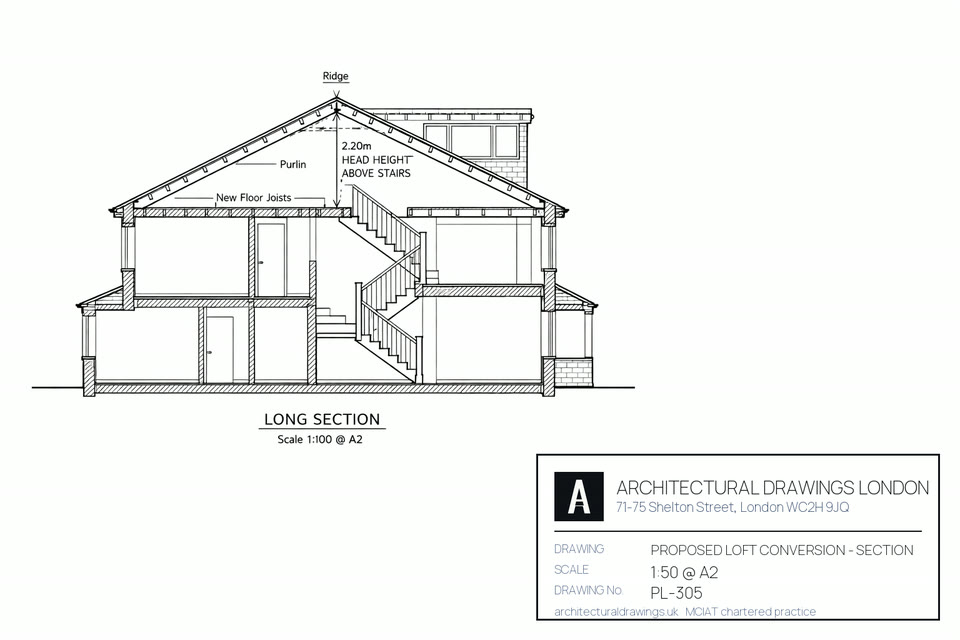
- Camden Town (NW1) — dense mixed-use, Victorian terraces, canal-side defines Camden Town, where victorian terraces, mansion blocks set what a loft conversions can do. The Victorian butterfly and double-pitched roofs on these streets normally clear the 2.2 m head height a dormer conversion needs once the ceiling joists are raised across NW1. Any Camden Town loft conversions is validated by Camden Council, with Camden Market the usual Camden Town reference point on the site plan.
- Near Camden Town: Gospel Oak (NW5) — Victorian terraces and estates near the Heath defines Gospel Oak, where victorian terraces, post-war estates set what a loft conversions can do. The Victorian butterfly and double-pitched roofs on these streets normally clear the 2.2 m head height a dormer conversion needs once the ceiling joists are raised across NW5. Any Gospel Oak loft conversions is validated by Camden Council, with Gospel Oak station the usual Gospel Oak reference point on the site plan.
- Near Camden Town: West Hampstead (NW6) — a loft conversions in West Hampstead starts from edwardian mansion blocks, victorian villas, and West Hampstead reads as Victorian and Edwardian villa streets. The Victorian butterfly and double-pitched roofs on these streets normally clear the 2.2 m head height a dormer conversion needs once the ceiling joists are raised in NW6. Camden Council assesses West Hampstead loft conversions against its own West Hampstead character guidance, and the location plan we draw for West Hampstead references West Hampstead Thameslink.
- Near Camden Town: Hampstead (NW3) — affluent, listed Georgian and Victorian villas defines Hampstead, where georgian and victorian villas, listed buildings set what a loft conversions can do. Georgian roofs here are shallow and often behind a parapet across NW3. Any Hampstead loft conversions is validated by Camden Council, with Hampstead Heath the usual Hampstead reference point on the site plan.
- Near Camden Town: Primrose Hill (NW1) — loft conversions work in Primrose Hill means victorian and edwardian terraces. Primrose Hill is boutique village atmosphere, painted terraces. The Victorian butterfly and double-pitched roofs on these streets normally clear the 2.2 m head height a dormer conversion needs once the ceiling joists are raised throughout NW1. Camden Council decides the Primrose Hill application, and Primrose Hill park anchors the Primrose Hill location plan.
- Near Camden Town: Kentish Town (NW5) — Victorian terraced streets, gentrifying defines Kentish Town, where victorian terraces set what a loft conversions can do. The Victorian butterfly and double-pitched roofs on these streets normally clear the 2.2 m head height a dormer conversion needs once the ceiling joists are raised across NW5. Any Kentish Town loft conversions is validated by Camden Council, with Kentish Town City Farm the usual Kentish Town reference point on the site plan.
- Near Camden Town: Belsize Park (NW3) — tree-lined avenues, Edwardian mansion blocks defines Belsize Park, where edwardian mansion blocks, victorian villas set what a loft conversions can do. The Victorian butterfly and double-pitched roofs on these streets normally clear the 2.2 m head height a dormer conversion needs once the ceiling joists are raised across NW3. Any Belsize Park loft conversions is validated by Camden Council, with Belsize Park station the usual Belsize Park reference point on the site plan.
Does Camden Town planning policy restrict a loft conversions?
Conservation areas covering Camden Town: the council runs 40, and Camden Town, Fitzrovia and Hampstead are the three owners here meet most often. Inside one, the permitted development route for a loft disappears, and the submission becomes a householder application: £548, decided in 8 weeks, in place of the 6-week prior approval route and its £249 fee. In Hampstead the street elevation is judged before the plan is. Designation does not stop a dormer; a conservation area moves the argument onto the roof's public face.
What Article 4 removes near Camden Town: Article 4 removes permitted development for HMO conversions (C3 to C4) across the borough, plus restrictions on basement extensions in 12 conservation areas. Before pricing a loft conversions we check whether the NW1 address is inside the mapped area, because Camden Council draws the Camden Town boundary street by street rather than across the whole of Camden Town.
Digging below a Camden Town property: Camden's basement policy (Policy A5) restricts single-storey basements to 50% of garden area; double-storey basements generally refused outside commercial zones. Where a loft conversions in Camden Town involves excavation that is read beside the Party Wall etc. Act 1996, which needs two months notice for a Camden Town dig within 3 m of a neighbour, and Camden Council expects the NW1 ground conditions addressed in the application.
Camden Town housing stock: Victorian and Edwardian terraces, Georgian townhouses in Bloomsbury and Hampstead, post-war mansion blocks, modern developments in King's Cross. Creative, affluent in Hampstead and Primrose Hill; dense mixed-use around Camden Town and Kings Cross; academic character in Bloomsbury. Read that before choosing a loft conversions route in Camden Town — construction, not postcode, sets what is achievable.
Which neighbouring authorities border Camden Town?
- Westminster — adjoining Camden Town, with 56 conservation areas centred on SW1. A loft conversions on the far side of the Camden Town line is determined by Westminster City Council, so the Camden Town quote for loft conversions is checked against Westminster guidance before it is issued.
- Islington — adjoining Camden Town, with 40 conservation areas centred on N1. A loft conversions on the far side of the Camden Town line is determined by Islington Council, so the Camden Town quote for loft conversions is checked against Islington guidance before it is issued.
- Barnet — cross the Camden Town boundary and Barnet Council takes the loft conversions instead, applying 20 conservation areas of its own around N2. We re-price loft conversions at the Camden Town edge because Barnet policy and Camden policy rarely align on loft conversions depth.
- Haringey — adjoining Camden Town, with 29 conservation areas centred on N4. A loft conversions on the far side of the Camden Town line is determined by Haringey Council, so the Camden Town quote for loft conversions is checked against Haringey guidance before it is issued.
Sources for this Camden Town loft conversions page: borough policies maps and
conservation-area registers (2025–26), Royal Mail postcode district boundaries,
the Town and Country Planning (Fees for Applications) (England) Regulations, the Town
and Country Planning (General Permitted Development) (England) Order 2015 as amended,
and the Party Wall etc. Act 1996.