Key facts at a glance
- Velux (rooflight) conversion: cheapest — £15,000–£25,000 but limited headroom
- Rear dormer: most common — £35,000–£55,000, works on terraces and semis
- Hip-to-gable + dormer: largest space — £45,000–£75,000, semis and detached only
- Velux conversions often need no planning permission; dormers may or may not
- Headroom is the key constraint for Velux; volume limits for dormers
- All three need building regulations approval
Which of the three loft types needs an application?
Only the ones that change the roof volume. A rooflight conversion sits under Class C and uses no allowance. A dormer and a hip-to-gable both draw on Class B’s 40 cubic metres on a terrace or 50 on a semi, and neither survives inside a conservation area.
| Rooflight | Rear dormer | Hip-to-gable | |
|---|---|---|---|
| Permitted development class | C | B | B |
| Volume allowance used | none | part of 40 or 50 m³ | most of 40 or 50 m³ |
| Projection limit | 150mm beyond the roof plane | set back 200mm from the eaves | set back 200mm from the eaves |
| Front roof slope | allowed, subject to limits | not permitted | not permitted |
| Above the existing ridge | not permitted | not permitted | not permitted |
| Inside a conservation area | restricted if facing a highway | not permitted development | not permitted development |
| Needs a hip to begin with | no | no | yes |
Source: Town and Country Planning (General Permitted Development) (England) Order 2015, Schedule 2, Part 1, Classes B and C, as amended, read at 1 September 2026. The volume allowance is cumulative and measured against the roof as originally built, so a previous dormer counts against it — which is what usually forces a hip-to-gable and dormer to be designed as a single scheme.
When does a rooflight conversion work?
A Velux or rooflight conversion uses the existing roof structure without adding any external extensions — it installs rooflights into the existing roof slope and converts the existing loft space into a habitable room. This is the simplest and cheapest loft conversion type, costing £15,000–£25,000 to convert an existing loft.
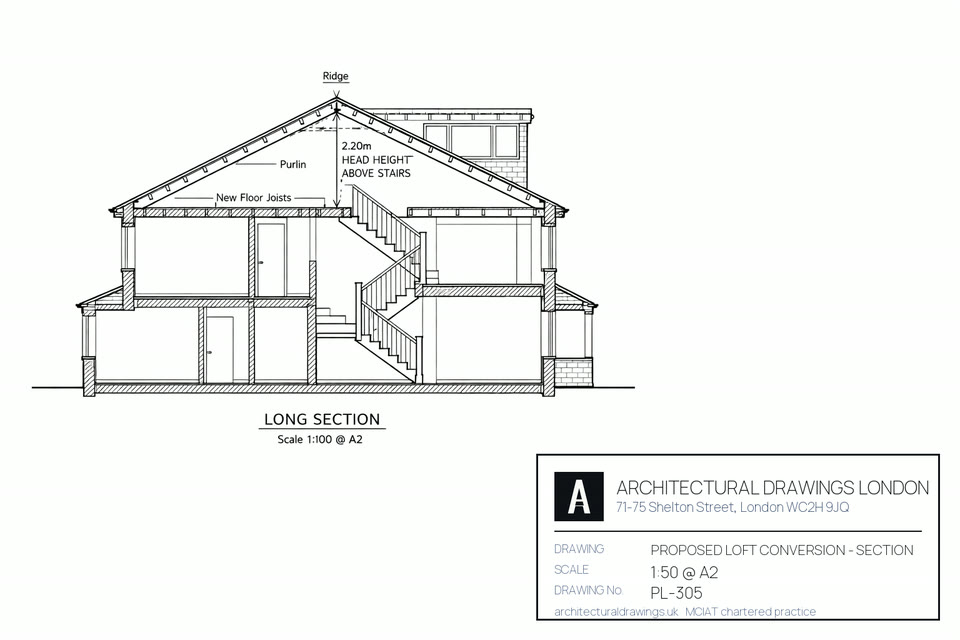
The fundamental limitation is headroom. The usable floor area with 2.2 m headroom (the Building Regulations minimum for a habitable room) is determined entirely by the existing roof pitch and ridge height. On a steep Victorian roof (45+ degrees), a Velux conversion can be very effective. On a shallow 1960s roof (25–30 degrees), the 2.2 m zone may be too narrow for practical use.
Planning: rooflight conversions that do not alter the existing roof profile are generally permitted development. They are the most planning-friendly loft option.
When is a rear dormer the right answer?
A rear dormer is the standard London loft conversion — a vertical box-shaped extension built out from the rear slope of the roof. It creates new vertical wall space at the rear, dramatically increasing the usable floor area regardless of the original roof pitch. A full-width rear dormer on a Victorian terrace typically creates a loft floor of 30–45 m² with 2.4–2.7 m headroom throughout.
Rear dormers cost £35,000–£55,000 to build and are permitted development in most London properties not in Article 4 areas. They are the optimal balance of cost, planning simplicity, and usable space for terraced houses.
When do you need a hip-to-gable as well?
The L-shape combines hip-to-gable (infilling the hipped end on a semi or detached) with a full-width rear dormer. This creates the maximum loft floor area from a single project — typically 35–50 m² on a 1930s semi. Two bedrooms and a bathroom is the standard output.
The L-shape costs £45,000–£75,000 and can be permitted development on properties meeting the 50 m³ volume limit. It is the standard choice for semi-detached homeowners wanting maximum loft space.
Which type suits your house?
Detached or semi: If your loft already has good headroom, Velux is cheapest. If not, go L-shape — the extra cost delivers significantly more usable space.
Victorian/Edwardian terrace: Full-width rear dormer — standard choice, best value.
Conservation area, inner London: Check Article 4 status. If PD rights are removed, you need planning permission for any dormer — budget accordingly.
Verdict
Velux if headroom exists and budget is tight. Rear dormer for terraces — the right balance of cost and space. L-shape (hip-to-gable plus dormer) for semis wanting maximum space.
Frequently asked questions
Which loft conversion is cheapest?
A Velux (rooflight) conversion is cheapest at £15,000–£25,000. It uses the existing roof structure and requires no external structural additions. However, usable space is limited by the existing roof pitch.
Do all loft conversions need planning permission?
No. Velux conversions typically don't (they don't alter the external roof profile). Rear dormers and hip-to-gable conversions are often permitted development, but require a Lawful Development Certificate if you want documentary evidence of lawfulness.
What is the minimum roof pitch for a Velux conversion?
A usable Velux conversion typically requires a roof pitch of at least 40 degrees to achieve the minimum 2.2 m headroom over an adequate floor area. Below 35 degrees, the usable zone is often too narrow for a habitable bedroom.
How long does a loft conversion take?
Velux conversion: 4–6 weeks. Rear dormer: 8–12 weeks. L-shape (hip-to-gable plus dormer): 10–14 weeks. These are on-site build times after drawings and approvals are in place.
Can I have a Velux and a dormer?
Yes. Some loft conversions combine a rear dormer for main headroom with additional Velux rooflights on the front slope for natural light. This is a common design on Victorian terraces where front-facing rooflights are acceptable under planning policy.