Key facts at a glance
- Single storey: simpler planning, lower cost, suits most properties
- Double storey: more space per £ of building cost, higher planning complexity
- Single storey PD limit: 3 m on semis, 4 m on detached (or 6/8 m via LHES)
- Double storey always needs full planning permission — no PD route
- Double storey costs 60–80% more to build but adds 90–120% more floor area
- Both need building regulations drawings regardless of planning route
Does a second storey change the planning route?
Completely. A single-storey rear extension can be permitted development at 3m, or 6m under prior approval. A two-storey rear extension is only permitted development where it stays within 3m of the original rear wall and 7m of the rear boundary — so most London double-storey schemes need a full application.
| Limit | Single storey | Two storey |
|---|---|---|
| Rear depth, terrace or semi | 3m, or 6m under prior approval | 3m, no prior approval route |
| Rear depth, detached | 4m, or 8m under prior approval | 3m |
| Distance to the rear boundary | no fixed minimum | at least 7m |
| Maximum height | 4m | no higher than the existing roof |
| Roof pitch on the upper storey | — | must match the existing house |
| Side extension of two storeys | not permitted development | not permitted development |
| On Article 2(3) land | not permitted development | not permitted development |
Source: Town and Country Planning (General Permitted Development) (England) Order 2015, Schedule 2, Part 1, Class A, paragraphs A.1 and A.2, as amended, read at 1 September 2026. The 7m rear-boundary rule is the test that removes most two-storey extensions in London from permitted development, because typical terraced gardens are shorter than that once the extension is built.
How does the planning route differ?
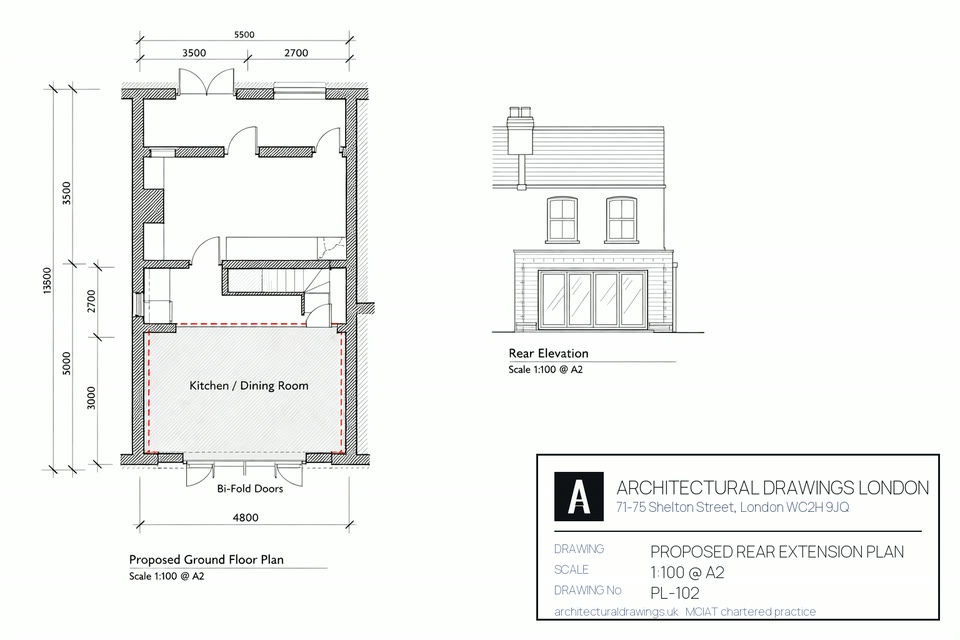
Single-storey rear extensions can proceed via permitted development on most London properties — no planning application required, just a Lawful Development Certificate if you want legal confirmation. The standard PD limit is 3 m depth on semis and terraces, 4 m on detached houses. The Larger Home Extension Scheme (LHES) extends this to 6 m and 8 m respectively via a simple prior approval process.
Double-storey extensions have no PD route. Every two-storey rear extension requires a full householder planning application. The main policy test is the 45-degree rule applied from the nearest neighbouring habitable window — this limits how deep a two-storey extension can be before it overshadows neighbours. Most London boroughs also require upper-floor windows to be at high sill levels (1.7 m+) or obscure-glazed to address privacy concerns.
What does each option cost in London?
Single-storey rear extensions typically cost £45,000–£80,000 to build in London, depending on size, specification, and finishes. A 4 m × 6 m single-storey extension adds approximately 24 m² of new floor space.
Double-storey extensions cost £75,000–£130,000 for a similar footprint — the additional cost reflects the structural frame, staircase modifications, and more complex building regulations. However, a two-storey extension of the same footprint adds roughly 48 m² of new floor space, making the cost per square metre considerably lower than two separate single-storey phases.
Added value in London
In London's property market, floor area is the primary value driver. A single-storey 24 m² extension typically adds £60,000–£120,000 to a property's value depending on the borough. A double-storey 48 m² extension adds £110,000–£220,000. Both tend to return more than their build cost in London's higher-value boroughs.
The double storey is particularly efficient in inner boroughs where garden depth is limited — if you can only build 3 m deep before hitting your garden constraints, going up doubles your return without reducing garden further.
When should you choose single storey?
Choose single storey when: you want to avoid planning permission risk, your budget is under £80,000, you want a faster programme (8–12 weeks vs 12–18 weeks for two-storey), or the planning policy in your area makes a two-storey application marginal. Conservation areas often make double-storey extensions difficult to approve.
When is double storey worth it?
Choose double storey when: you need significantly more space (e.g. adding a bedroom as well as kitchen), you are planning to stay long-term, your garden can absorb the footprint, and your neighbours are unlikely to object. The cost per m² is lower, and the value uplift per £ spent is generally higher.
Verdict
If budget and planning risk are the main constraints, build single storey first via PD. If you need maximum space and can navigate a planning application, double storey delivers more floor area per pound spent.
Frequently asked questions
Does a double storey extension always need planning permission?
Yes. There is no permitted development route for two-storey rear extensions. A householder planning application is always required.
Can I build single storey first then add a second storey later?
Yes, but you will need planning permission for the second phase. The planning officer will assess the complete two-storey result, so the cumulative impact on neighbours is considered. It is generally more efficient to apply for both storeys at once.
What is the 45-degree rule for extensions?
The 45-degree rule checks that a proposed extension does not block daylight to the nearest habitable window of a neighbouring property by more than 45 degrees. It is measured in both plan and elevation. It primarily limits how deep a two-storey extension can be relative to neighbouring windows.
How long does planning permission take for a double storey extension?
Householder planning applications have an 8-week statutory determination period in England, but many London boroughs take 10–14 weeks in practice. Barnet, Croydon, and Sutton tend to be faster; Haringey, Hackney, and Tower Hamlets are typically slower.
Are building regulations required for both?
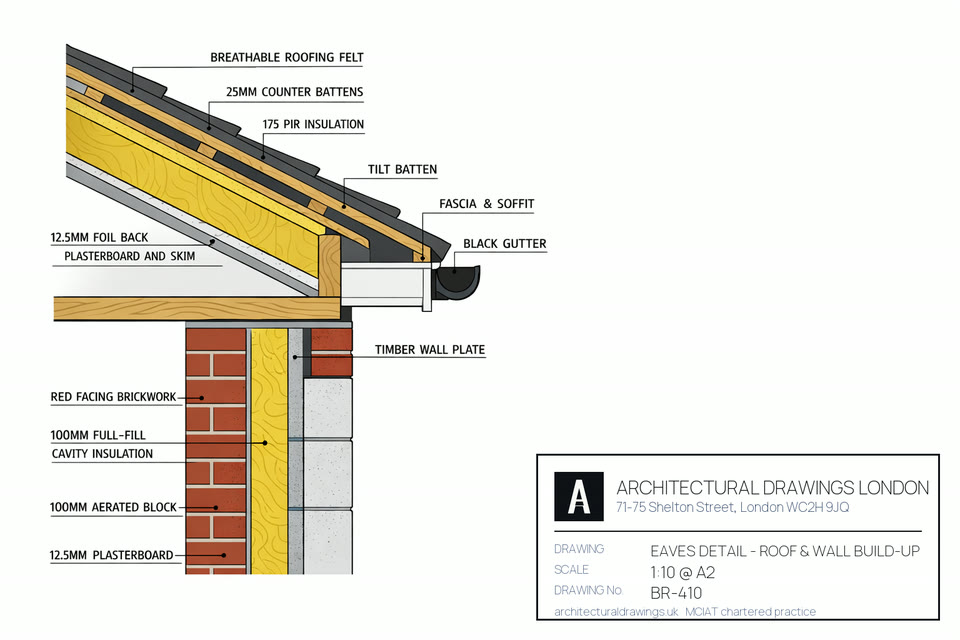
Yes. All extensions require building regulations approval regardless of the planning route. Building regulations cover structure, insulation, fire safety, drainage, and energy performance. Full Plans submission is recommended — it gives your builder an approved specification before starting on site.