Key facts at a glance
- Side return: infills the narrow gap beside a terrace — typically adds 10–18 m²
- Wraparound: extends both rear and side simultaneously — adds 20–35 m²
- Both need planning permission on semis; may be PD on detached
- Side return costs £35,000–£60,000; wraparound costs £55,000–£90,000
- Wraparound creates a stronger open-plan flow but reduces garden more
- Victorian and Edwardian terraces are the primary candidates for both
Side return or wraparound — which needs permission?
The wraparound, always. A side return alone can be permitted development at up to half the original house width; wrapping it around the rear makes the two one enlargement under Class A, and the combined width test then fails. That is a full application at £548.
| Side return alone | Wraparound | |
|---|---|---|
| Permitted development | possible under Class A | no |
| Width limit | half the original house | combined enlargement fails it |
| Rear depth limit | 3m terrace or semi | not applicable |
| Application fee | £274 certificate, or £548 | £548 |
| Available inside a conservation area | no | no |
| Party wall notice | usually | usually, both walls |
| London householder approval rate | 83.0% | 83.0% |
Sources: the Town and Country Planning (General Permitted Development) (England) Order 2015, Schedule 2, Part 1, Class A; fees from the Fees for Applications Regulations 2012 as amended, 2026 rates; approval figures from MHCLG PS1 and PS2, twelve quarters to March 2026; the Party Wall etc. Act 1996. Read at 1 September 2026.
What is a side return extension?
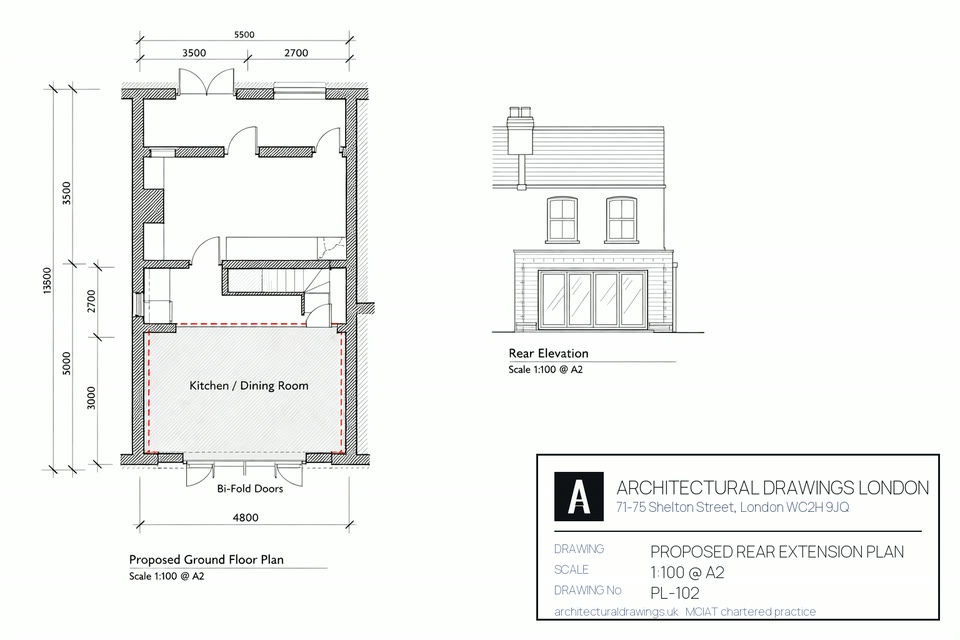
Victorian and Edwardian terraced houses were built with a narrow gap — typically 600 mm to 1.8 m wide — running alongside the kitchen at the rear. This void was originally used for coal storage, drainage, and access. A side return extension infills this gap, widening the existing ground floor by the width of the return and typically extending it slightly to the rear. The result is a much wider kitchen-diner with improved natural light from the side elevation.
What is a wraparound extension?
A wraparound extension combines a side return infill with a full rear extension, creating an L-shaped addition that runs the full width of the rear and wraps around into the side return. It is the maximum-area ground floor extension option on a terrace — typically adding 20–35 m² of new space. The combined plan allows a large open-plan kitchen, dining area, and living space with dual-aspect glazing to the rear garden and a rooflight over the side return section.
Planning: when is permission required?
Side returns on semi-detached houses almost always need planning permission — extending to the side of a semi is not covered by PD rights when the extension exceeds half the width of the original house. On a detached house, a side extension within PD limits may be possible without permission, but this is uncommon on Victorian stock.
Wraparound extensions, by definition, extend in two directions simultaneously — the side element always triggers the planning requirement on a semi or terrace. A householder planning application covering both the rear and side elements is the standard approach.
The key design choices
The side return section has lower headroom potential than the main rear extension — the neighbouring wall typically limits how high you can build on the boundary. Most architects and architectural technologists design the side return with a glazed or translucent roof (frameless glass or polycarbonate) to bring light in from above without obstructing the neighbour's outlook.
The planning officer's main concern on wraparound extensions is the impact on the street scene from the side elevation and the impact on the neighbouring property from the boundary wall. Setting the boundary wall back from the property boundary by 50–100 mm — and using glazing rather than solid materials — typically addresses both concerns.
Verdict
If your side return is less than 1.2 m wide, a simple side return infill maximises light without major structural cost. If you can extend at least 2–3 m to the rear simultaneously, the wraparound delivers far more usable space for marginal additional cost.
Frequently asked questions
Does a side return extension need planning permission?
On a terrace or semi, yes — extending to the side is not normally covered by PD. On a detached house, a narrow side extension may be PD if it meets the relevant criteria. A Lawful Development Certificate or planning application is required in most cases.
How wide can a side return extension be?
The width is determined by the existing side return gap. Typically 600 mm–1.8 m on Victorian terraces. The extension fills this gap to the boundary, gaining the full width of the return.
Will a side return extension block my neighbour's light?
It can. The party wall along the side return typically has windows from the neighbouring kitchen or utility room. A structural engineer's party wall assessment and potentially a party wall award are required. In most cases, the impact is manageable and accepted by neighbours.
What is the party wall procedure for a side return?
If your extension is on or within 3 m of the party wall (which a side return typically is), you must serve party wall notices on the adjoining owner under the Party Wall etc. Act 1996. They can consent or appoint a surveyor. Most straightforward side returns are resolved by consent.
What roof should a side return extension have?
A frameless glass or polycarbonate roof is standard — it allows daylight into the extension without adding bulk visible from the street. Some designs use a continuation of the main flat roof with a large rooflight over the side section.