Key facts at a glance
- Flat roofs cost 15–25% less to build than equivalent pitched roofs
- Most London councils accept flat roofs on rear extensions — it is the modern standard
- Pitched roofs are often required in conservation areas to match the host building
- Modern flat roofs (EPDM or GRP) last 25–50 years with minimal maintenance
- Pitched roofs suit properties where the extension is visible from the street
- Roof lanterns and glazed roofs only work on flat roof structures
Does the roof shape change what you can build without permission?
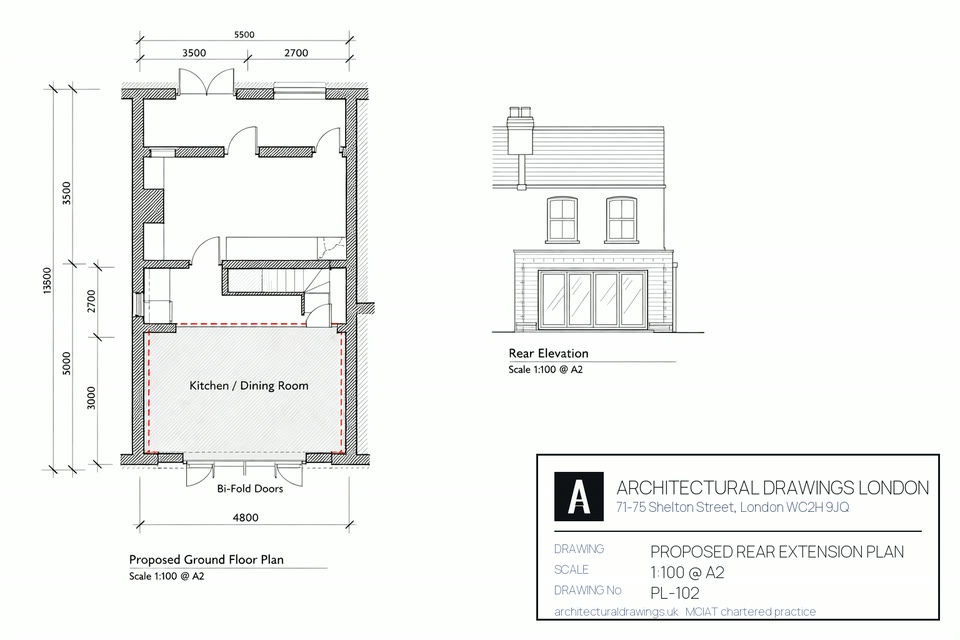
Yes, through the height limits. A single-storey rear extension is capped at 4m overall and 3m at the eaves within two metres of a boundary, so a pitched roof over a 4m-deep extension usually breaches one of them. A flat roof clears both comfortably.
| Permitted development limit | Value | Effect |
|---|---|---|
| Maximum height, single-storey rear extension | 4m | a pitch over a deep extension often exceeds it |
| Eaves height within 2m of a boundary | 3m | the binding limit on most terraces |
| Rear depth, terrace or semi | 3m, 6m under prior approval | — |
| Rear depth, detached | 4m, 8m under prior approval | — |
| Materials | similar in appearance to the existing house | roof finish is assessed |
| On Article 2(3) land | not permitted development | full application either way |
Source: Town and Country Planning (General Permitted Development) (England) Order 2015, Schedule 2, Part 1, Class A, paragraph A.1, as amended, read at 1 September 2026. The 3m eaves rule is measured from the natural ground level, and it applies to any part of the extension within two metres of the boundary — which on a London terrace is usually the whole of it.
What do London planning officers actually say?
The majority of London boroughs accept flat roofs on rear extensions as the default — the 2016 National Planning Policy Framework abandoned the earlier preference for pitched roofs to match host buildings. Planning officers across Southwark, Lambeth, Lewisham, and Wandsworth routinely approve flat-roof rear extensions on Victorian and Edwardian terraces without conditions.
Conservation areas are the exception. Many conservation area character appraisals specify that extensions should use materials and forms sympathetic to the host building — which on a Victorian terrace typically means pitched roofs in slate or clay tile. If your property is in a conservation area, check the specific character appraisal before committing to a flat roof design.
Which roof costs more to build?
A flat roof extension costs approximately £1,200–£1,600/m² to build in London. A pitched roof extension of the same footprint costs £1,400–£1,900/m² — the additional cost reflects the roof structure (rafters, ridge, purlins), the covering (tiles or slate), and the longer labour time to build the pitch correctly. For a typical 4 m × 5 m extension, the flat roof option saves £3,000–£8,000.
How long does each roof last?
The old reputation of flat roofs as leak-prone is outdated. Modern EPDM (rubber) flat roofs carry 20-year manufacturer warranties and last 30–50 years in practice. GRP (fibreglass) roofs are similarly durable. The key is a properly designed drainage fall (minimum 1:40) and quality installation. A flat roof installed correctly in 2026 will outlast most pitched roofs on the cost-of-maintenance comparison.
Pitched roofs do have the advantage of passive water shedding — rain leaves the roof surface faster on a 35-degree pitch than on a 1:40 flat. In London's climate, this is a marginal factor when both roof types are properly installed.
Roof lanterns and glazed roofs
The primary functional advantage of a flat roof is the ability to incorporate roof lanterns, frameless glazing, and structural rooflights. These are not possible on a pitched roof without a separate dormer or rooflight. Flat roof extensions with large overhead glazing are the current standard for kitchen-diners in London, and many planning officers actively support them as a high-quality design response.
Verdict
For most rear extensions in London, a flat roof is the better choice — lower cost, accepted by planners, and enables overhead glazing. Opt for pitched only if your property is in a conservation area or the extension will be visible from the street.
Frequently asked questions
Do flat roofs need planning permission?
No more than pitched roofs. Planning permission is triggered by the size and location of the extension, not the roof type.
What is the best flat roof material for a London extension?
EPDM (rubber membrane) is the most widely specified material for new flat roofs in London — durable, fully welded seams, 20-year guarantee. GRP (fibreglass) is also excellent for smaller roofs. Avoid built-up felt on new construction.
Can I put a roof terrace on a flat roof extension?
Yes, but it requires planning permission even if the extension itself was permitted development. The roof terrace adds a new level of activity that can affect neighbours' privacy, which planning officers assess carefully.
Will a flat roof extension devalue my home?
No. A well-designed flat roof extension adds value. Estate agents and surveyors value extensions by floor area, not roof style. Flat roofs on rear extensions are now the norm and are not penalised in valuations.
How much fall does a flat roof need?
A minimum 1:40 fall (2.5%) is required to ensure drainage. Many builders specify 1:60 falls which are technically acceptable but marginal — insist on 1:40 or steeper, especially for EPDM roofs with welded seams.