Key facts at a glance
- Outbuildings under 2.5 m eaves height don't need planning permission in most gardens
- Outbuildings cost £15,000–£40,000; an equivalent extension costs £45,000–£80,000
- Outbuildings cannot be used as separate dwellings without planning permission
- A well-insulated outbuilding can be as comfortable as an extension for year-round work
- Extensions add permanent floor area that counts toward the property value
- Outbuildings don't need building regulations for structures under 15 m² (some caveats apply)
Outbuilding or extension — which rules apply?
Different classes entirely. An extension sits under Class A with a depth limit; an outbuilding sits under Class E with a height limit of 2.5m within two metres of a boundary. Both draw on the same 50% curtilage allowance, so one eats the other.
| Limit | Extension, Class A | Outbuilding, Class E |
|---|---|---|
| Governing limit | depth from the original rear wall | height and position |
| Rear depth, terrace or semi | 3m, 6m under prior approval | not applicable |
| Height within 2m of a boundary | 3m at the eaves | 2.5m overall |
| Height, flat roof, elsewhere | 4m | 3m |
| Height, dual-pitched roof | 4m | 4m |
| Forward of the principal elevation | not permitted | not permitted |
| Shared allowance | 50% of the curtilage | 50% of the curtilage |
Source: the Town and Country Planning (General Permitted Development) (England) Order 2015, Schedule 2, Part 1, Classes A and E, as amended, read at 1 September 2026. The curtilage allowance is cumulative across both classes, which is why a large garden room can remove the headroom for a future extension — and why sleeping accommodation in an outbuilding takes it outside Class E altogether.
When an outbuilding works
A garden outbuilding — studio, home office, or workshop — is the fastest and cheapest way to create a separate work space without altering the main house. Under permitted development, an outbuilding with eaves no higher than 2.5 m and a maximum ridge height of 4 m (3 m if within 2 m of a boundary) does not require planning permission on most residential properties. An outbuilding under 15 m² footprint and not used as a dwelling also does not require building regulations, though good insulation and a stable electrical connection should still be designed in.
The practical limitation of outbuildings is the separation from the house. In London winters, walking 20 m across a wet garden to reach a cold outbuilding each morning is a genuine friction point. A well-insulated timber-frame outbuilding with underfloor heating and fibre broadband resolves most of this — but it is a different experience from stepping out of the kitchen into an extension.
When an extension works better
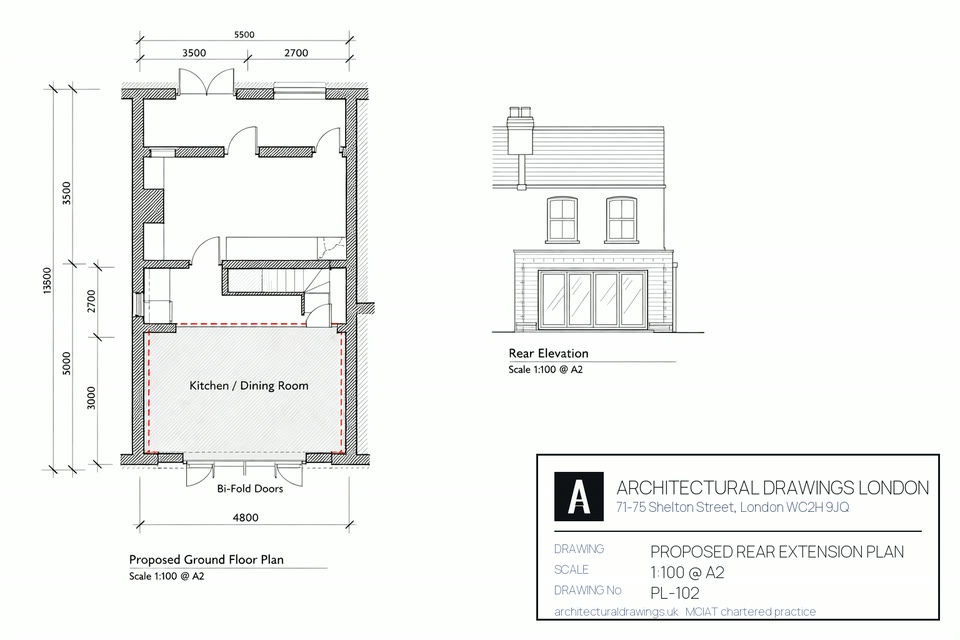
If you want the new workspace to be directly connected to the main house — accessible from the kitchen or hallway without going outside — an extension is the only option. An extension also adds permanent floor area that is classified as habitable space, which counts toward the property's overall floor area measurement and increases value. An outbuilding, even a high-quality one, is not classified as habitable floor area and does not add to the measured floor area of the house.
The extension is more expensive and disruptive to build, but the quality of connection to the rest of the house is categorically different. If you plan to sell in the next 5 years, an extension adds more to the sale value than an outbuilding of equivalent construction cost.
Planning in practice
Most outbuildings in London gardens proceed without planning permission provided they comply with PD limits. The main restrictions are: not in front of the principal elevation, not covering more than 50% of the garden area, and eaves below 2.5 m. In conservation areas, permitted development rights for outbuildings are more restricted — check with the council before proceeding.
Verdict
For a home office used primarily for focused work, a quality outbuilding is the faster, cheaper option. For a space you will use all day, every day, in all weather, and which you want to add to your property's value, extend the house.
Frequently asked questions
Can I sleep in a garden outbuilding?
An outbuilding can be used for occasional sleeping (e.g. as a guest room) without changing its planning use class. Permanent use as a bedroom or self-contained dwelling requires planning permission.
Does an outbuilding need building regulations?
Outbuildings under 15 m² with no sleeping accommodation and not close to a boundary do not require building regulations. Larger structures do. Regardless, proper insulation, damp-proofing, and electrical installation to BS 7671 are strongly recommended.
How much does a quality garden office cost?
A timber-frame garden office with insulation, electrics, double glazing, and cladding costs £15,000–£40,000 in London (2026), depending on size and specification. Higher-end units with underfloor heating and acoustic insulation reach £40,000–£60,000.
Will an outbuilding add value to my house?
A well-built outbuilding adds modest value — buyers appreciate the space. However, it does not add to the measured floor area of the house, so it does not affect the £/m² valuation the same way an extension does.
Can I have broadband and heating in an outbuilding?
Yes. Running power to an outbuilding requires a registered electrician and, for a permanent structure, an armoured cable from the consumer unit. Fibre broadband can be run on the same external route. Underfloor heating (electric) is common in outbuildings.