Berkshire has had no county council since 1998 — six unitary authorities run planning independently, and they differ sharply. Windsor and Maidenhead is Green Belt and heritage-led; Reading and Slough are urban; West Berkshire is a National Landscape.
The national ones, applied by six unitary authorities — Reading, Slough, Bracknell Forest, West Berkshire, Wokingham and Windsor and Maidenhead. Fees and permitted development limits are identical everywhere: £548 for a householder application, 3m rear on a semi, 6m under prior approval.
Rule or fee
Value
Source
Householder planning application
£548
Statutory, England 2026
Lawful development certificate
£274
Statutory
Larger home extension prior approval
£249
Statutory
Rear extension, terrace or semi
3m, or 6m under prior approval
GPDO 2015, Class A
Rear extension, detached
4m, or 8m under prior approval
GPDO 2015, Class A
Added roof volume for a loft
40 m³ terrace, 50 m³ semi or detached
GPDO 2015, Class B
Inside a conservation area or National Landscape
Class A side extensions and Class B removed
GPDO 2015, Article 2(3)
Sources: the Town and Country Planning (Fees for Applications) (England) Regulations 2012 as amended, 2026 rates; the General Permitted Development (England) Order 2015, Schedule 2, Part 1, Classes A and B, and Article 2(3). Read at 1 September 2026. Berkshire has had no county council since 1998; the six unitary authorities each adopt their own local plan, which is what varies between them.
Which council decides your Berkshire application?
Berkshire County Council was abolished in 1998, and unusually for southern England there is no two-tier structure at all. Six unitary authorities each act as the sole planning authority for their area: the Royal Borough of Windsor and Maidenhead, Reading Borough Council, Slough Borough Council, Wokingham Borough Council, Bracknell Forest Council and West Berkshire Council.
That matters practically because there is no county tier to fall back on for minerals, waste or highways coordination in the way a shire county provides. Every consultation is internal to the unitary, which tends to make determination timescales more predictable but local policy more variable.
6
Berkshire unitary authorities
Drawings from, fixed
£548
Householder council fee
What constrains building across Berkshire?
Eastern Berkshire sits in the Metropolitan Green Belt, covering most of the Royal Borough of Windsor and Maidenhead outside the towns, and parts of Slough and Bracknell Forest. The disproportionate-addition test applies there in the same way as in Surrey and Hertfordshire.
The Thames is the second constraint and the one most often underestimated. Flood Zone 2 and 3 designations follow the river through Maidenhead, Windsor, Datchet, Wraysbury and into Reading, bringing a flood risk assessment, minimum finished floor levels and, on many sites, a requirement for flood-resilient construction and compensatory storage. It regularly rules out basements outright.
Heritage is concentrated around Windsor, where the castle, the Great Park and the historic town core produce dense conservation-area and listed-building coverage, and around the older cores of Maidenhead, Reading, Newbury and Hungerford. In the west, the North Wessex Downs National Landscape covers much of West Berkshire, adding a landscape and visual test to rural schemes.
What kind of work do we do across Berkshire?
Rear and wrap-around extensions in Maidenhead, Wokingham and Bracknell, where post-war plots are generous enough for the 4 metre and 8 metre detached-house allowances to be genuinely usable.
Loft conversions across the interwar and post-war stock of Slough, Reading and Woodley — usually a £274 certificate rather than a full application.
Heritage alterations in Windsor, Eton, Cookham and Hungerford, where listed building consent frequently runs alongside the planning application and carries no fee of its own.
Flood-zone schemes along the Thames corridor, where finished floor levels and flood-resilient construction shape the design from the first sketch rather than being added later.
Rural and downland schemes in West Berkshire inside the North Wessex Downs National Landscape, assessed on landscape impact, materials and prominence.
Package
Fixed fee
Turnaround
Essentials — measured survey, existing and proposed plans
One of six unitary authorities — Windsor and Maidenhead, Reading, Slough, Wokingham, Bracknell Forest or West Berkshire. Berkshire County Council was abolished in 1998, so there is no second tier and the unitary is the sole planning authority.
Will the Thames flood plain affect my project?
If the property sits in Flood Zone 2 or 3 — which follows the river through Maidenhead, Windsor, Datchet, Wraysbury and Reading — you will need a flood risk assessment, and the design will be shaped by minimum finished floor levels, flood-resilient construction and often compensatory storage. Basements are frequently ruled out.
Can I extend a Green Belt property near Windsor?
Yes, subject to the disproportionate-addition test measured against the original dwelling. Most of the Royal Borough of Windsor and Maidenhead outside the towns is Metropolitan Green Belt, and prior extensions count against the allowance.
Do I need listed building consent as well as planning permission?
If the building is listed, yes, and they are separate applications. Listed building consent carries no statutory fee, but it requires a heritage statement and a fuller level of drawn detail than a planning application alone.
How much do Berkshire drawings cost?
Last updated: 28 July 2026 · Written by the Architectural Drawings London
technical team, chartered members of the Chartered Institute of Architectural
Technologists (MCIAT). · About our team
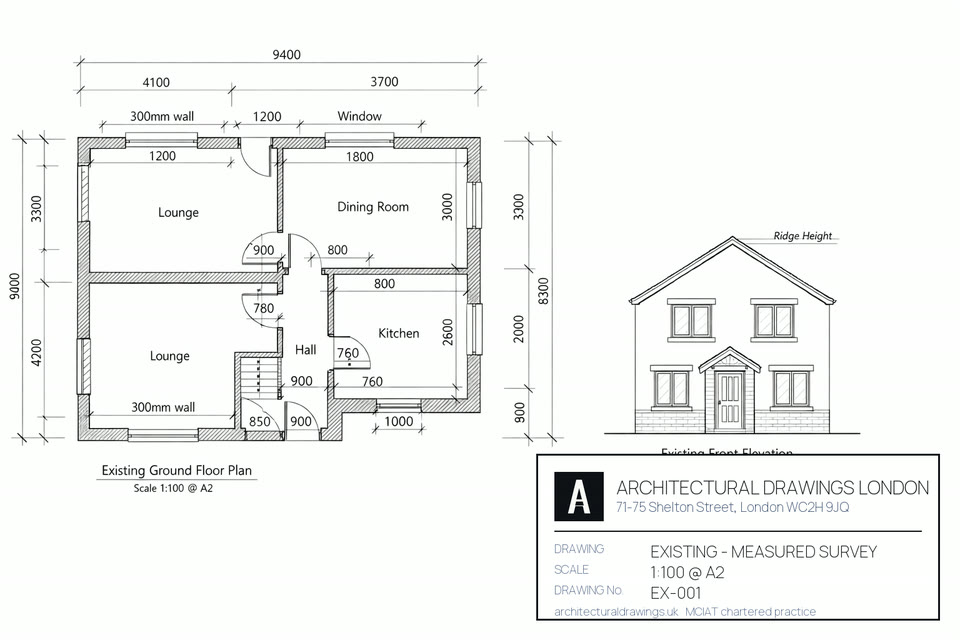
Measured surveyEvery dimension recorded on site in a measured survey before a line of the proposal is drawn.
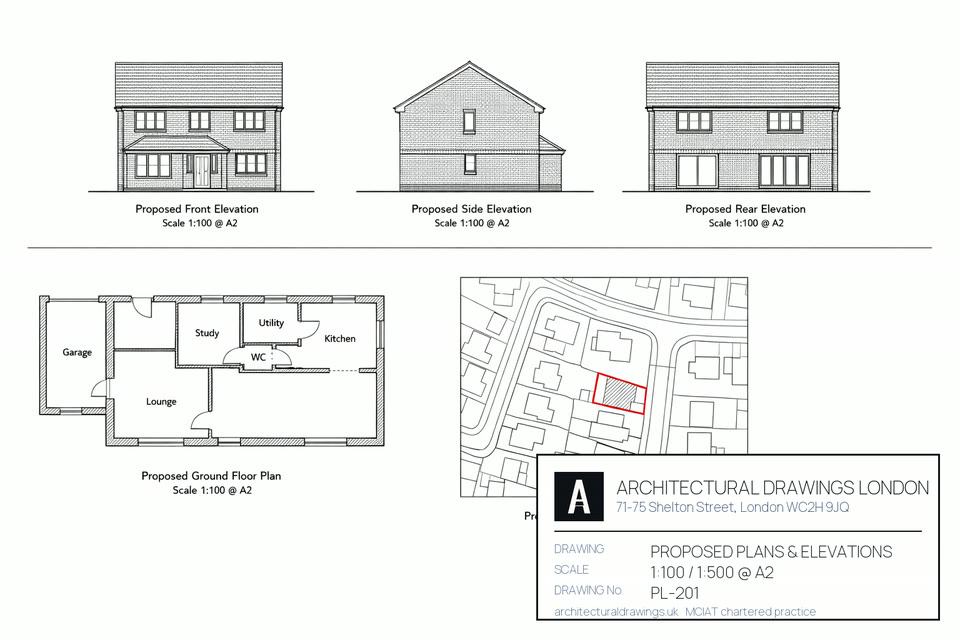
Planning application setExisting, proposed and location plans on one sheet — as the council receives it through the Planning Portal.
Every set is checked line by line against the validation checklist before it leaves the office.
Get a Berkshire project priced
Send the postcode. We confirm the authority, the Green Belt and flood position and the application route before quoting.